
ITA&S-F — The ITA&S Enterprise Architecture Framework
Most EA frameworks treat business and IT as parallel tracks. ITA&S-F was designed to integrate them — using Business Dimensions as the connective tissue across roadmaps, metrics, and data.
Business Dimensions
We introduced Business Dimensions as a core concept to:
- Scope EA roadmaps
- Qualify metrics and KPIs used to monitor whether processes meet their goals
- Support the Enterprise Dimensional Data Model
Examples of Business Dimensions include: Organization, Industry, Location, Role, Product, Service, Segment, and Channel.
A Focused Set of EA Artifacts
Enterprise Architects cannot realistically maintain the 50+ artifacts defined in TOGAF while remaining responsive to the business. ITA&S-F focuses on a deliberately limited set of EA artifacts — called EA Persistent Products — whose lifecycles are long and whose maintenance can be sustained without overwhelming the EA practice. This leaves sufficient capacity to deliver EA Offerings when the business needs them.
EA Persistent Products must be maintained in an EA tool. The primary role of these tools is to manage relationships and maps across all architecture objects. Since ITA&S-F introduces new concepts such as Business Dimensions, we developed a dedicated metamodel and implemented it in Casewise.
Decoupling Architecture from Projects
One of ITA&S-F's most important design principles is the separation of architecture dependencies from project dependencies:
- Architecture roadmaps are maintained independently of program and project timelines
- Versioned architecture objects — representing specific architectural changes — are associated with programs and projects
- When a program or project changes scope or timeline, the versioned architecture object is simply reassigned — the architecture roadmap remains unaffected
- This approach also enables monitoring of when silo program or project decisions prevent the organization from reaching its business objectives, since all versioned architecture objects are tied to business objectives
This decoupling is fully integrated into the ITA&S-F metamodel in Casewise, significantly simplifying the maintenance of architecture roadmaps.
EA Offerings
We believe Enterprise Architecture groups should be structured as EA Practices — maintaining a defined catalog of EA Services and Offerings available to their business customers. The EA Persistent Products exist precisely to ensure the practice is always ready to deliver these Offerings on demand. EA Offerings have direct business value and include:
- Strategic guidance on business direction and renewal
- Plans and roadmaps
- Business Case support
- IT Budget Planning for application portfolios
- Software and product recommendations
- Assessments
- Solution Architecture guidance
- Advice on the IT side of a merger & acquisition
- ...
When demand arises for these Offerings, there is no time to revisit and update persistent EA products such as application inventories, business process maps, or data models. The discipline of maintaining them continuously is what makes the EA Practice credible and responsive.
While ITA&S-F stands on its own, this approach is fully compatible with and can be overlaid on established frameworks such as TOGAF and FEA.
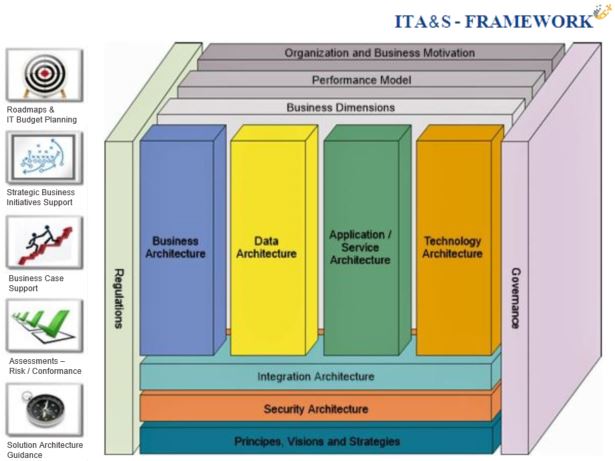
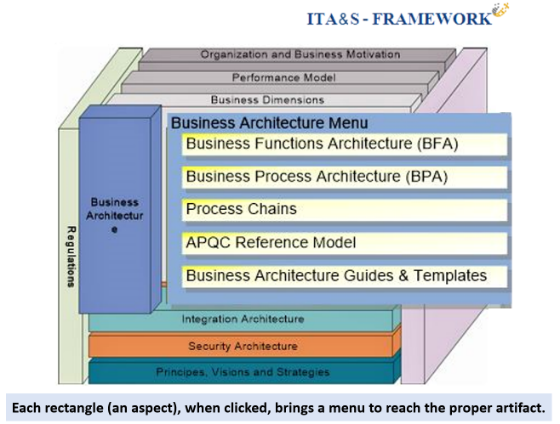
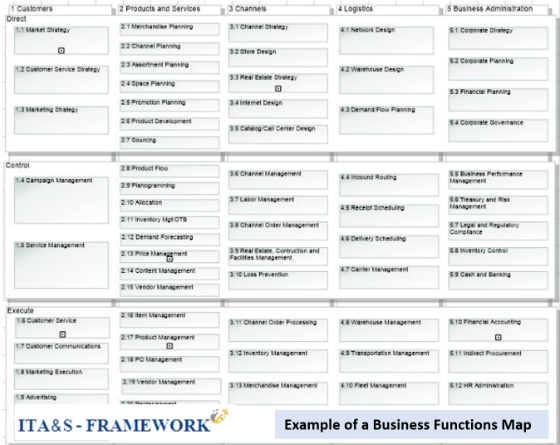
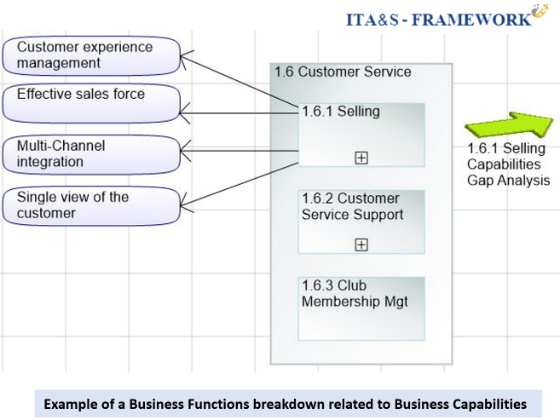
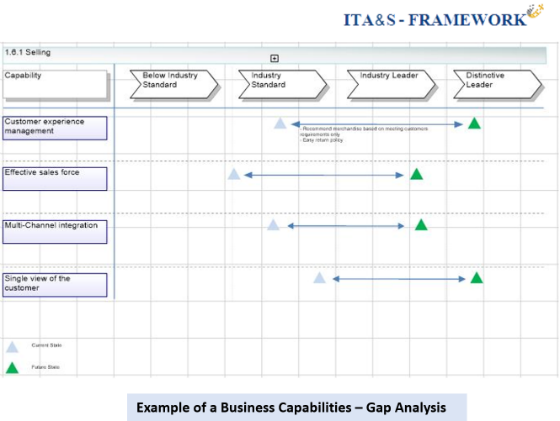
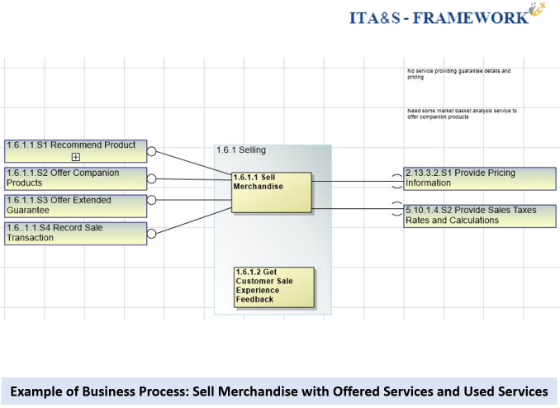

The challenge is to focus on a smaller number of EA artifacts that supports production of tangible results such as: roadmaps, EA due diligence during mergers and acquisitions, support for solution architecture teams, and others.
The ITA&S-F pictures are screenshots taken from its implementation as an accelerator in Casewise.

From the Archives:
These articles were originally written between 2006 and 2011 and reflect the thinking and experience that directly shaped our current platforms and methodologies. They have been selectively refreshed to align terminology and references with today's standards, while preserving the original reasoning and architectural principles that remain as relevant as ever.